


If you are a working-class Muslim in India today and speak Bengali, you are likely to be living in mortal fear of the state stripping you of your citizenship overnight, throwing you into a detention centre or pushing you across the international border to neighbouring Bangladesh.
And this, when India is home to around 200 million Muslims; and when Bengali is the most widely spoken language in India after Hindi.
Anwar Ali, a Bengali migrant worker in Mumbai laments that “ if you speak Bengali, wear a lungi, or cook fish and meat, you’re harassed… Now, speaking Bengali makes you look like a criminal”. His contractor has even advised him over the phone: “Speaking Bengali is dangerous. Learn Hindi, stop wearing lungis.” Lungis are chequered pieces of cloth that Muslim Bengali men often wear below their waists. Ali can change his attire. However, he asks piercingly, “How can I change my mother tongue?”
In May 2025, Bangladesh’s Foreign Ministry wrote to the Indian government demanding that it follows established repatriation mechanisms. It describes “push-ins” – what we describe in India as “pushbacks” – to be “unacceptable”. It affirmed that Bangladesh would “only accept individuals confirmed as Bangladeshi citizens and repatriated through proper channels.”
Supreme Court hears the case of alleged indian nationals deported to Bangladesh (Union vs Bhodu Shekh)
— Bar and Bench (@barandbench) May 22, 2026
SG Mehta: We have instructions. The government will bring them back. Ascertain their status and take steps as needed. Please record this is in peculiar facts of the case and… pic.twitter.com/BpXTCABqHk
Again, more recently, the Bangladesh army has warned against what it describes as India's “push-in’ deportation practices. Brigadier General Md Nazim-ud-Daula, Director of the Military Operations Directorate for the Bangladesh Army, described the forced return of undocumented persons by Indian authorities as “unacceptable,” and said the army was prepared to intervene if instructed by the government.
He said that all repatriations should take place “through proper channels”. “Bangladesh does not engage in ‘push-ins’ like India but believes in resolving issues through diplomacy,” he declared. This has been formally raised by Bangladesh’s Ministry of Foreign Affairs and has formally raised the matter with India, according to the Bangladesh general.
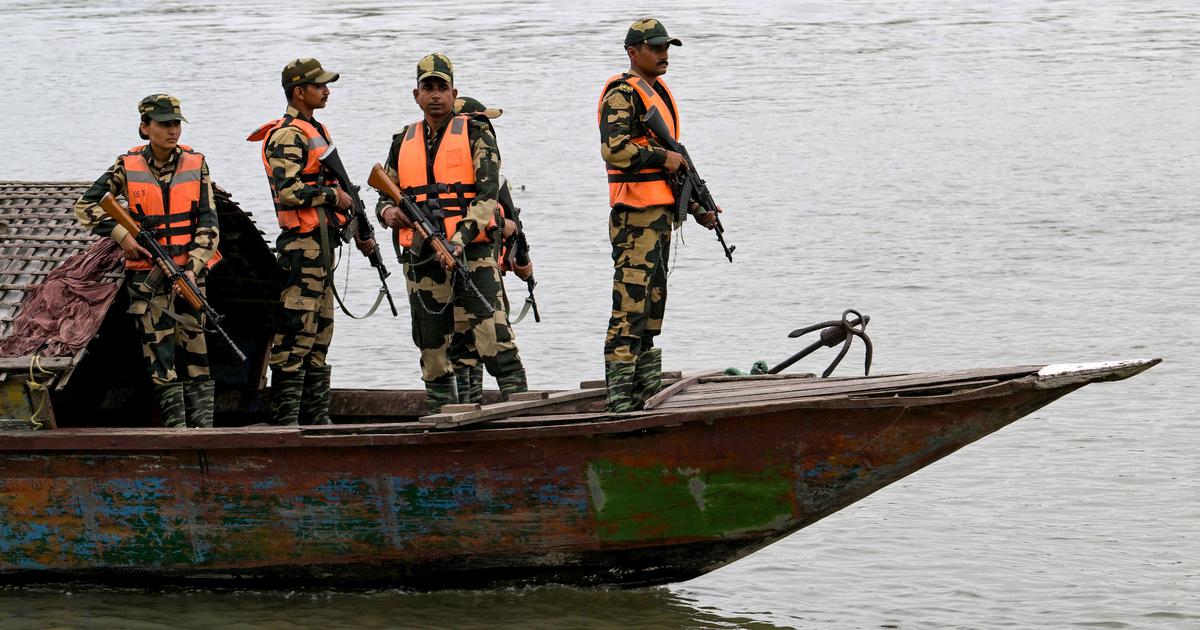
The policy of “pushback” is an extra-judicial process of forcefully pushing people the state alleges to be illegal immigrants across international borders at gunpoint. It is a staggering sleight of hand targeting primarily people of Muslim identity. To strip a person of citizenship rights is to deny them access even to most fundamental rights guaranteed to citizens in the Constitution. Without these rights, a person cannot vote, cannot access welfare schemes like subsidised rations, housing and pensions. A person is effectively rendered “stateless”. And a destiny of incarceration in detention centres and forceful “pushbacks” by armed soldiers into a land with which the person has no links looms large.
Until the Bharatiya Janata Party victory in the midsummer election in West Bengal, “push-backs” were conducted across the borders with Bangladesh in Assam and Tripura, both with BJP governments. Of the 4,096-km border of India by Bangladesh, 2,217 km, or more than half of the full length fell in West Bengal, which was not available so far for “push-back” operations. But now with the triumphalist installation of a BJP government in West Bengal, most stretches of the border of India with Bangladesh now resound with threats of “push-backs”.
It is baleful that alleged “infiltration” from Bangladesh was central to the BJP election campaign. It was a theme that Union Home Minister Amit Shah continuously returned to, claiming shrilly that “infiltrators” were stealing the jobs, rations and security of the Bengali people. And tellingly, one of the first announcements by West Bengal Chief Minister Suvendu Adhikari after the elections was to declare that the time had come to deport “infiltrators”.
He speaks of his government’s touch approach of “detect, delete, deport”. District magistrates have been asked to establish adequate infrastructure for “holding centres” for illegal immigrants and foreigners. These are intended, state officials explain, for those illegal immigrants who do not qualify for citizenship under the Citizenship Amendment Act 2019 – namely only Muslims
The government also announced that those who had been struck off electoral rolls because they could not produce documents that satisfied the election commission would be denied access even to subsidised rations.
Five generations of her family have lived in a West Bengal village, land records show
— Supriya Sharma (@sharmasupriya) September 4, 2025
Yet pregnant Sunali Khatun has been pushed into Bangladesh by Indian authorities
We met her mother and daughter - picture by @raghavKakkar30, report by @AnantGuptaAG https://t.co/9zisUXgkB8
Legalising ‘pushbacks’
You might say that any sovereign nation operates well within international law by expelling illegal aliens residing in its territory. Indeed if we accept the framework of the modern nation-state there can be little objection if people are established to be foreigners who are illegally living in the country and then they are legally deported to the nation to which they belong, always following due process and in consultation with the nation to which the illegal immigrant belongs.
In the context of Myanmar, because the Rohingya face grave threats to their life and liberty if handed over to the Myanmar military government, the international principle on non-refoulement restrains any forceful return of persons even if they are illegally residing in India.
What would a lawful process of deportation from India to Bangladesh entail? It would require the Government of India to give details to the embassy or high commission of the country to which Indian authorities claim that the undocumented person belongs. Only if the embassy or high commission verifies the nationality of the person, the person is legally deported to her or his home nation.
However, “pushbacks” in India do none of this. These are done without judicial due process and without engaging in any way the country into which a person is pushed.
Let us contrast this with the large numbers of undocumented “illegal” immigrants sent to India by the Trump administration in the United States of America in his second term. The Trump administration does not simply fly these people into India. It acts while communicating the details of these persons to the Indian embassy. What we must understand is that the people who the American authorities are sending back to India (with or without shackles) are indisputably Indian citizens. There is no contestation by both governments and by the person that the undocumented person is Indian.
USBP and partners successfully returned illegal aliens to India, marking the farthest deportation flight yet using military transport. This mission underscores our commitment to enforcing immigration laws and ensuring swift removals.
— U.S. Border Patrol Chief (@USBPChief) February 5, 2025
If you cross illegally, you will be removed. pic.twitter.com/WW4OWYzWOf
This is entirely different from the processes of “pushback” under way in India. Here it is only the Indian authorities, often without due process, who allege that a person is a Bangladeshi citizen. This is firstly contested by the person who is being “pushed back”. And the Bangladesh government is not informed nor consulted, nor is it requested to verify that the person is in fact a Bangladeshi citizen.
For persons who India claims are Bangladeshis illegally residing in India, lawful processes of deportation are rarely resorted to. Instead, the overwhelming majority of persons who have been forcefully “pushed” across the border are persons whom the Indian state dubs to be “illegal”, most often by flawed and truncated processes.
The details of these persons are not communicated to the Bangladesh High Commission, nor are the Bangladeshi authorities given the opportunity to confirm that these persons resident in India are actually Bangladeshi citizens. This brazenly contravenes international law, and indeed India’s constitutional guarantees of the fundamental right to life, liberty and due process that extend also to non-citizens.
A law passed by Parliament in 2025 attempts to give a legal veneer to the extra-judicial practice of “pushback” or forced expulsion of persons judged by the state to be aliens. This is the Immigration and Foreigners Act of 2025, which has received presidential assent and is therefore the law of the land. According to this law, if the state suspects a person to be a foreigner who is living in India illegally, it will first detain the person in a “holding centre” (codeword for a detention centre). Local police and administrative officials will conduct a summary enquiry within 30 days of this detention. If the person is unable to prove her Indian nationality within this time, the person can be removed forcefully from the country.
Scroll rightly describes this as a “procedurally flawed, opaque and onerous legal process that reflects the fraught terrain of Indian citizenship and belonging”. Since the law makes no mention of consulting with the authorities of the nation to which the person is alleged to belong, this in effect legalises the practice of pushback.
First, the starting point for the operation of the law is suspicion on the part of the police or the law enforcement agencies that a person is a Bangladeshi national who has crossed into India illegally. The basis for such suspicion is not specified in the law. It therefore leaves the door wide open for the exercise of this power by local state officials or senior government functionaries based on prejudices of class, religion, language and ethnicity. Impoverished working class Bengali-speaking Muslims are unsurprisingly most imperilled by this law.
Second, this law reverses the burden of proof. This means that the state is not required to prove that the person that it has identified to be “suspicious” is in fact an illegal alien. Instead all that is required for the executive to adjudge a person to be an illegal immigrant – and, armed with this conclusion, to push her across the international border – is simply for the person to be unable in the prescribed time of 30 days to muster the necessary documents to prove her citizenship.
Given the reality of the lower-end bureaucracy dealing with unlettered, impoverished and powerless persons, it is highly unlikely that the “suspected” illegal resident would be able to gather in this small window the necessary documentation to establish that they are Indian citizens.
Third, until now there was at least some semblance of a judicial process before the executive could conclude that a person was an illegal alien. The enquiry now under the 2025 law is entirely conducted by state officials. No appeal mechanism has been specified in the law, meaning that a summary and opaque executive decision becomes final and binding.
The “pushback” policy has become an alternative process now dressed up as law, with “little oversight and safeguards, which risks creating stateless individuals while placing the burden on marginalised groups to prove Indian citizenship”.
We have seen comments of this nature being made in the last several days. These comments must be seen in the context of the core issue of the repatriation of illegal Bangladeshis from India. This obviously requires cooperation from Bangladesh.
— All India Radio News (@airnewsalerts) May 7, 2026
Over 2,860 cases of nationality… pic.twitter.com/f0B2NYpWWW
Cruelty of pushbacks
Even before the 2025 law that gave “pushbacks” a faux legal veneer, these had become commonplace. Muslim migrants, usually Bengali speaking, were rounded up from around the country, thrown into “holding centres”; they were sometimes flown to BJP-ruled states of Tripura and Assam and pushed across the international border to Bangladesh.
However, the implementation of the 2025 laws, the BJP victories in West Bengal and Assam, and the ideological biases of the state establishment have made life even more perilous for people of the targeted identities. If you are Muslim, Bengali and working-class and live or work in BJP-ruled states, there is a high chance that the system would treat you as a suspected infiltrator.
Tripura Chief Minister Manik Saha informed the state assembly in 2025 that 3,518 illegal immigrants were detained in the state over the past three years, of whom 2,739 were pushed back to “their” countries. Saha said that in 2022, 982 illegal entrants were caught, followed by 1,072 in 2023, 1,007 in 2024, and 412 till August 2025. Among them were Bangladeshis, Rohingyas, and a few nationals from Nigeria and France. Push-back operations saw 911 sent back in 2022, 657 in 2023, 690 in 2024, and 481 till August 2025.
The signs are ominous. The language is itself telling. Undocumented Hindus, Tibetans and Sri Lankan Tamils are routinely described as “refugees”. Muslims who are unable to produce documents of citizenship and the Rohingya are called “infiltrators”, indicating not simply that they are undocumented but that they are security threats.
Even the prime minister alludes to the dangers that they pose – in his 2025 Independence Day address – to the nation from the Red Fort. He announces a high-powered demography mission to deal with the threat. “No country can hand itself over to infiltrators”, he thunders, “how then can we allow India to do so?”
40 Rohingya refugees were allegedly blindfolded, beaten, and forced onto an Indian Navy vessel—then thrown into the sea.https://t.co/jDz0yx4ZuN
— Scroll.in (@scroll_in) May 17, 2025
They swam back to Myanmar, the country they had fled to escape genocide.
Vineet Bhalla reports pic.twitter.com/d1y1PrmthO
Detention centres are now called “holding centres”. Many have come up in major migration hubs like Assam, New Delhi, Gujarat, Goa, Tamil Nadu and most recently in Mumbai. People detained in these speak of them as frightening places of detention without even the protections of ordinary jails, even though those detained in them are not criminals. I could not access official data on the numbers of detention centres for “illegal immigrants” across India.
Parichay, a legal aid clinic in the Global Jindal University, reports that RTI applications for these details to the Union home ministry receive the response that this information is not currently being maintained. In 2020 Parichay reported “illegal immigrants” in Punjab being held in the Amritsar Central Jail, in Rajasthan in Alwar jail and in Bihar in a military camp.
In national crisis points like the aftermath of the terrorist attack in Pahalgam in Kashmir in March 2025, along with Rohingya refugees, Muslim, Bengali and working-class migrants are rounded up in large numbers from working class settlements and slums. It is as though their Muslim identity and Bengali tongue make them somehow complicit in the terror crimes. They are held in holding centres and some among them are flown to the international borders and “pushed” across at gunpoint.
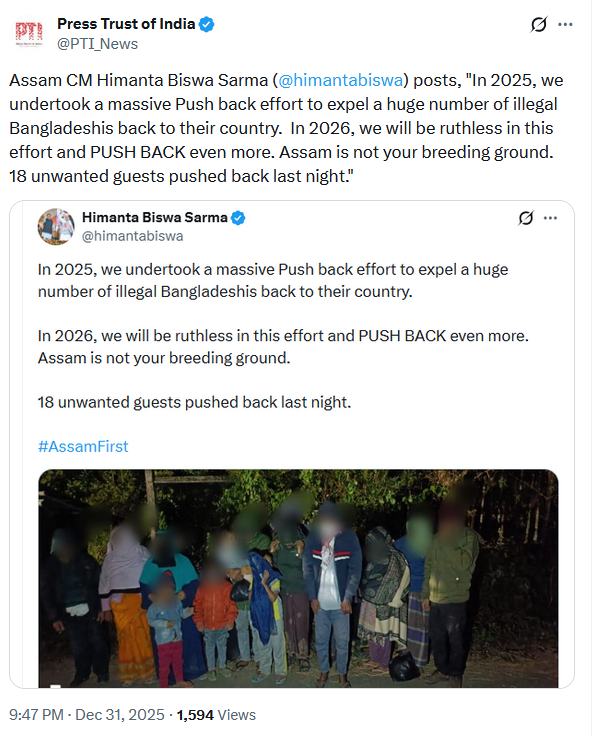
In Assam, the BJP chief minister Himanta Biswa Sarma, boasted as a badge of honour that his government had “pushed back” 330 alleged illegal immigrants into Bangladesh over barely a month after the Pahalgam attack. “It is not possible for them to return”, he claimed, describing migration from Bangladesh and Pakistan to be a security threat and a threat to the language and culture of Assam. “I am an Assamese first and only then a chief minister”, he declared. In the future, he said, the state would also expel people without involving Foreigners Tribunals and even if their name was in the National Register of Citizens. In another move that was openly partisan, he declared an amnesty for all non-Muslims whose cases were pending before the Foreigners' Tribunals.
“Many names were manipulatively and cleverly included in the NRC [National Register for Citizens],” the #Assam chief minister said. “The way the NRC process was conducted has raised serious doubts and concerns.”
— Scroll.in (@scroll_in) June 12, 2025
Read more: https://t.co/QjXDpe88vX pic.twitter.com/aZs8rCkKUk
Human Rights Watch reports that in mid‑2025, hundreds of ethnic Bengali‑speaking Muslims were expelled from India into Bangladesh without due process, after authorities labelled them ‘illegal immigrants.’” Elaine Pearson, Asia director at Human Rights Watch, said, “The authorities’ claims that they are managing irregular immigration are unconvincing given their disregard for due process rights, domestic guarantees, and international human rights standards.” She was categorical that “India’s ruling BJP is fueling discrimination by arbitrarily expelling Bengali Muslims from the country, including Indian citizens.”
The Indian government has not made any official data on the number of people expelled, but Border Guard Bangladesh has reported that India expelled more than 1,500 Muslim men, women, and children to Bangladesh just between May 7 and June 15, including about 100 Rohingya refugees from Myanmar. The expulsions continued since then. These expulsions involve, sometimes, border guards allegedly threatening and beating the detainees to force them to cross into Bangladesh without adequately verifying their citizenship claims.
We see a recurring pattern of massive police crackdowns and detentions of Bengali-speaking migrant workers in BJP-ruled states on suspicion that they are Bangladeshi. Such reports came from Assam, Gujarat, Odisha, Maharashtra, Delhi and Madhya Pradesh through 1925.
“The Indian government is putting thousands of vulnerable people at risk in apparent pursuit of unauthorised immigrants, but their actions reflect broader discriminatory policies against Muslims,” Pearson said. “The government is undercutting India’s long history of providing refuge to the persecuted as it tries to generate political support.”
In Odisha, for instance, 400 Bengali migrant workers were detained by the police on the suspicion that they were Bangladeshi. The police seized their phones to check for calls to Bangladesh. They turned down identity cards like voter IDs and Aadhar cards as proof of their Indian citizenship. Instead, they asked them to call home and request their relatives to send birth and school certificates.
The migrants have “worked outside Bengal for years — something like this has never happened before”. The migrants report being desperately worried because they have few options for work and survival except migration which has become so fraught. The father of one of the arrested Bengali workers asked that, “when the released migrants come back, what will be their livelihood? They have to run families. Where will they go to work next?”
In Ahmedabad, directly after the Pahalgam terror attack, during the months of April and May 2025, the Ahmedabad Municipal Corporation demolished more than 7,000 homes. Most of these were of Muslim workers, labourers, and long-term residents who say they have lived in the city and in that location for decades. The authorities alleged that many in the settlement were “Bangladeshi infiltrators”, a suspicion that typically they did not feel called upon to justify.
There were widespread crackdowns in the slum shanty and over 6,500 people were detained ostensibly for citizenship verification. Through the hot summer and monsoon, thousands among them were rendered homeless. One of the residents, Rafi, said, “We had about 500 to 1,000 houses here. We lived here for 40 years. My mother came here after marriage, and the government never asked us for papers”. He added, “They should have regularised our homes instead of bulldozing them without warning. I have lived here all my life. My parents helped build this community. Suddenly, they just broke everything without proper notice. They said they are removing ‘Bangladeshis’ and illegal settlers. But what about the rest of us?”
In Maharashtra again, the authorities rounded up several internal migrants from West Bengal, and pushed an uncounted number of them across the border. Nazimuddin Sheikh was one of them. A 34 year-old migrant mason who had worked in Mumbai for five years suddenly found his home raided by the police. The police confiscated his mobile phone, tore up his identity documents and then flew him in a BSF plane along with over 100 others to the BJP-ruled Tripura state, which borders Bangladesh. “The [BSF] did not listen to us when we told them we are Indian,” he said. “If we spoke too much, they beat us. They hit me with sticks on my back and hands. They were beating us and telling us to say we are Bangladeshi.”
With eight others, he was then pushed into Bangladesh. In Bangladesh, the residents of a border village allowed him to call his relatives. Taking pity about their predicament, the villagers then took him to a local outpost of Border Guard Bangladesh, where the border guards handed him back to Indian officials.
Just 10 days to prove you are an Indian citizen.
— Supriya Sharma (@sharmasupriya) September 29, 2025
Assam has a new SoP.
“This is the Assam government’s way to put some kind of legal imprimatur on its policy of forcibly pushing suspected foreigners into Bangladesh.”@ZamanRokibuz_ reportshttps://t.co/BPO46YCgmG
A 1950 Assam law
The extra-judicial project of pushing people the state alleges to be foreigners across the international border to Bangladesh without due process, often called “pushback”, was implemented avidly first in Assam and then increasingly in other BJP-ruled states. To give this even greater muscle, the chief minister of Assam, Himanta Biswa Sarma, has weaponised a Partition-era law, and before this, parliament in mid-2025 has passed a statute that further powers “pushback”.
The 1950 law that has been exhumed and the new federal law that has been promulgated give a legal facade to a process that is essentially unjust, inhumane and an attack on the intentionality and morality of the constitution. An elaborate “legal” infrastructure of “holding centres”, foreigners’ tribunals, “pushbacks” and mass targeted evictions – often specifically targeting Bengali-speaking Muslim settlers and migrants – worryingly appears to be building blocks of a baleful project for manufacturing statelessness and eventually ethnic cleansing.
In the post-Partition turmoil of massive movements of populations across the new border, parliament legislated in 1950 a law that provided for summary investigations into citizenship and expulsions. But back then, the operation of this law was short-lived, because Jawaharlal Nehru quickly stopped its operation due to the dangers inherent in it of amenability for its misuse to deny Muslims Indian citizenship.
Amidst the turmoil and anxieties of Partition, the Indian government led by Nehru passed the Immigrants (Expulsion from Assam) Act 1950. To allay fears of Assam being swamped by massive migrations from East Pakistan, the law empowered the central government to expel “a person or a class of persons” who were “ordinarily resident outside India and have come into Assam” if it believed that their stay was “detrimental to the interests of the general public of India”.
There were two significant features of this Partition-era law. The first was to authorise the official assessment of a person’s citizenship through summary executive action rather than by any judicial process. The second was the exception the law made to not expel refugees fleeing Pakistan on account of “civil disturbances or fear of such disturbances”.
Historian Binayak Dutta observes that the law created “a legal foundation for differentiation between non-Muslim and Muslim migrants on the ground”. In effect, in 1950 what the law did was to give protection to Hindu migrants and to exclude Muslims from these protections. It is both these features of the 1950 law that the Assam chief minister 76 years later chose to weaponise when he exhumed the law.
However, the operation of this law back in 1950 was very brief. Nehru directed Assam chief minister Gopinath Bordoloi to stop deportations under the act after he signed with Pakistan Prime Minister Liaquat Ali Khan a pact in April 1950 to protect the interests of minorities in their countries.
The law then remained in abeyance for over 75 years until Assam chief minister Himanta Biswa Sarma decided to resurrect it. Without going to the legislature, the Sarma government simply issued a “standard operations procedure” under the 1950 law laying down that anyone suspected of being an illegal migrant would be required to prove they are Indian citizens within 10 days. If the evidence that the person presents is found to be “not sufficient/satisfactory”, the district commissioner “will record his opinion in writing identifying the person to be an illegal immigrant”, and order their expulsion within 24 hours. This, without referring them, as they did in the past, to the Foreigners’ Tribunals and central deportation rules.
For impoverished and poorly lettered Assamese Muslims of Bengali origin, the impact of the resurrection of the 1950 law and the “special operations procedure” issued by the state government has been immediate and calamitous. Research scholar Angshuman Choudhury believes that the new system will create “an incentive-based pathway for district commissioners to showcase their administrative performance by identifying as many ‘foreigners’ as possible”. He rightly predicted that “Bengali Muslim minorities will bear the full force of this bureaucratic regime of disenfranchisement.” “In Assam, when the government does not find foreigners, it makes them,” advocate Zaman said. Another lawyer said this procedure “turns the executive into the judge, jury, executioner”.
The traumatic National Register of Citizens was implemented in over six years. Now the time that a person is given to prove her citizenship is just 10 days. It would take much longer for a person even to apply for official documents. Second, with all their flaws, at least their applications were heard by the quasi-judicial Foreigners’ Tribunals.
For five years, the Centre said persons included in the NRC will be given an Aadhaar as per the SOP. The SOP was silent on the NRC left out.
— Rokibuz Zaman (@ZamanRokibuz_) October 6, 2024
Now the people who did not make it to the NRC also got Aadhaar.
Many questions remain unanswered.https://t.co/pS2IAtRoC3
According to a report by the National Law School of India University and Queen Mary University of London, led by Mohsin Alam Bhat, who teaches law at Queen Mary University, the foreigners’ tribunal system was untenable and fundamentally illegal, with little regard for due process and principles of natural justice. Admitting to all its flaws, the system at least allowed some kind of process, and importantly appeals to higher courts. Now all those routes have been slammed shut.
As Article 14 observes, “By allowing bureaucrats who have no judicial training or any experience in the specialized field of citizenship determination to dabble in it freely, the government is formalising a thoroughly discretionary, opaque and arbitrary regime of large-scale disenfranchisement”. After the summary 10-day investigation, when officials conclude that a person is a “foreigner”, it directs the person to remove himself or herself from the territory of India. What this means in practice is to consent to “pushback” into a country that is not your own, in which often you have no one who is your own.
Even more worryingly, this new norm of citizenship being determined by officials rather than by any judicial process is being replicated in other BJP-ruled states where BJP state governments are directing district authorities to identify and expel suspected illegals without relying on any judicial or quasi-judicial process.
Human Rights Watch found in Assam that several people whose appeals were pending in tribunals or courts were also detained and expelled to Bangladesh. It writes of a 51-year-old daily wage worker living in Barpeta district whose appeal was pending in the Supreme Court against an ex parte judgement in 2014 that had declared him an irregular immigrant. Still, the authorities detained him, and two days later, Border Security Force forcibly pushed him into Bangladesh after midnight and.
He said: “I walked into Bangladesh like a dead body. I thought they [the BSF] would kill me because they were holding guns and no one from my family would know.” There were five other men like him. In Bangladesh, after walking many hours, villagers directed them to a river island where they managed to cross back into India.
Khairul Islam, 51, a former schoolteacher from Assam, said the border officials tied his hands, gagged him, and forced him into Bangladesh, along with 14 others. “The BSF officer beat me when I refused to cross the border into Bangladesh and fired rubber bullets four times in the air,” he said. He smuggled his way back two weeks later.
They did not even inform the families of persons who were pushed across the border. The wife of Khairul Islam only discovered that her husband was in Bangladesh when a journalist showed her a video of her husband that had been taken by a Bangladeshi journalist.
A 69-year-old Maleka Khatun, who could not walk without assistance and had weak eyesight, was pushed alone into Bangladesh around 3 am. Her son found out when his mother called from a phone villagers lent her in a Bangladeshi village days later. She had spent six years in a detention centre and been released on bail in 2024. “I have no idea how to bring her back,” her son lamented.
Making bewatan
Hindutva, the ideology of the ruling BJP, never conceded the right of Muslims and Christians to live in India as equal citizens. It regards the adherents of these religions as persons of suspect loyalty, traitors to the Hindu nation. In the 100 years since the formation of the Rashtriya Swayamsevak Sangh and from even before this, Hindutva ideologues have made clear that they seek for them to be expelled or at least reduced to second-class citizenship.
The BJP-led government of Narendra Modi since 2014 has implemented key segments of the ideological project of the Rashtriya Swayamsevak Sangh. These include the building of a grand temple at the site of the Babri Mosque in Ayodhya, the annulment of the special constitutional status of what was India’s only Muslim-majority state, Jammu and Kashmir, and the promulgation in many states of a Uniform Civil Code.
In open or covert concert with Hindutva activists, the ruling regime has subjected Indian Muslims to a battery of hate crimes and often even genocidal hate speech; targeted bulldozers’ on Muslim abodes; attacked Muslim livelihoods, their worship and cultural symbols; and mounted calls for the demolition of a growing list of historical mosques to build Hindu temples over their ruins.
Each of these has ravaged the access to equal citizenship and rights of Indian Muslim citizens. However, for the BJP-RSS establishment, this was not enough. The second and third terms of the leadership of Narendra Modi have seen a series of official actions that have directly rendered the citizenship of Indian Muslims fraught and precarious.
These began with the unapologetically partisan implementation of the National Register of Citizens in Assam and the Citizenship Amendment Act 2019, which for the first time gave reduced rights to access Indian citizenship based on religious identity. And now you have the religious and language profiling of migrants, combined with the forcing at gunpoint of individuals alleged to be “foreigners” into Bangladesh. If you are a Bengali-speaking Muslim then this jeopardy of statelessness looms even more threateningly. This larger Hindutva project of manufacturing statelessness is what senior commentator Samar Halarnkar describes aptly as a “moral genocide”.
During the nationwide protests against the 2019 Citizenship Amendment Act, Muslim women often poignantly spoke to me of their fears of being rendered – using an Urdu word – bewatan. This literally means persons without a country.
The BJP-led national government and BJP state governments are weaponising law and executive authority to threaten Indians of Muslim identity by stripping them of their rights as Indian citizens. West Bengal has now joined this BJP project of manufacturing statelessness of millions.
Indeed, to render them bewatan.
I am grateful for extensive research support from Syed Rubeel Haider Zaidi.
Harsh Mander is a peace and justice worker and writer. He leads Karwan e Mohabbat, a people’s campaign for solidarity and justice for the survivors of lynching and hate violence. He is visiting faculty in the South Asia Institute of Heidelberg University. His latest book, Under Grey Smoggy Skies: Living Homeless on the Streets of Delhi Cities, is in the bookstores.
